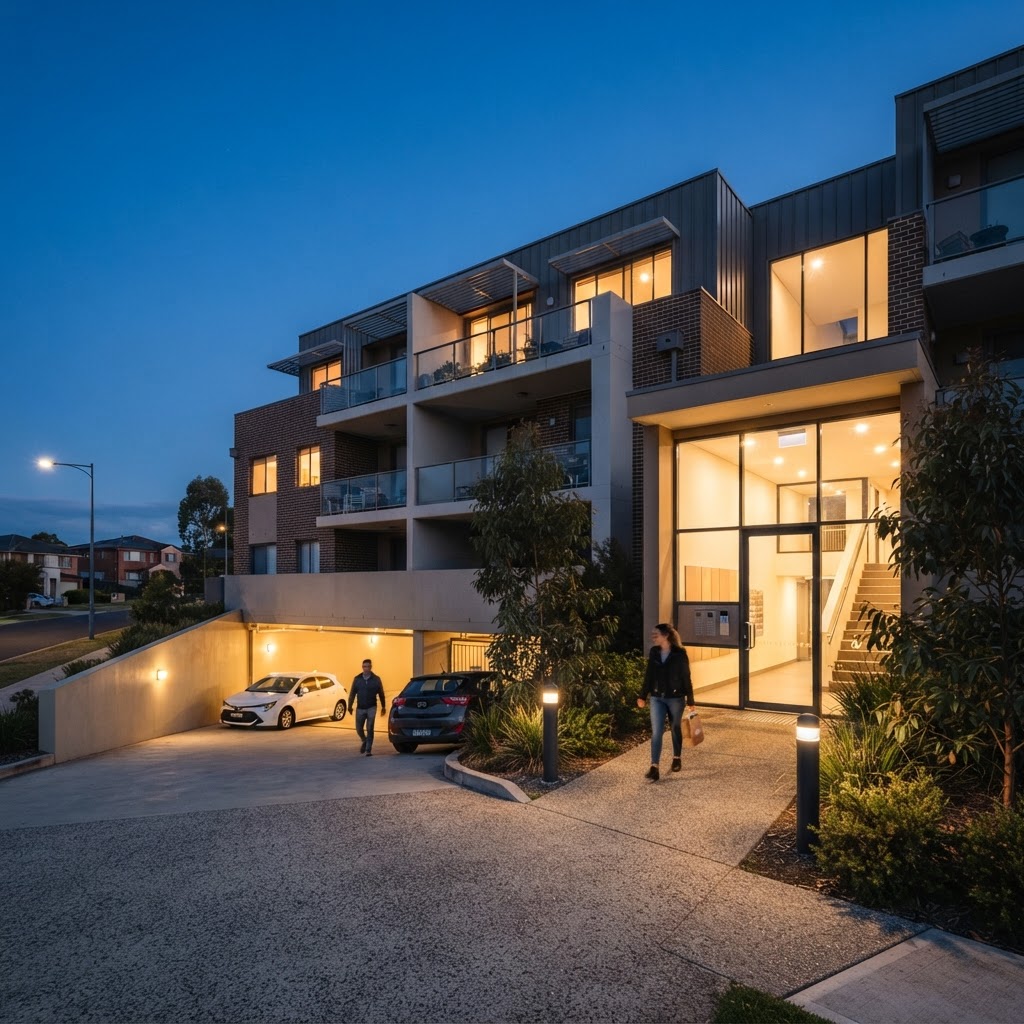
Ask any strata committee in Campbelltown what keeps them up at night and you'll get the same short list: car park break-ins, storage cage thefts, people sleeping in or loitering around stairwells, damage to foyers and intercoms, and residents who feel unsafe walking from the garage to their front door after dark.
Apartment buildings, townhouse complexes and mixed-use strata properties across Campbelltown, Narellan and the wider Macarthur region all share the same structural weakness: common property belongs to everyone and no one at once. Nobody is watching the garage at 2am. That's exactly the gap a well-built strata security plan closes — and it costs less than most committees assume.
Why Strata Property Is a Different Security Problem
A detached house has one owner, one door and one person who notices when something's wrong. A strata building has dozens of owners, multiple entry points, shared infrastructure and a committee that meets monthly at best. Three things follow:
- Access multiplies risk. One compromised garage door, one fire exit propped open by a resident taking the bins out, one visitor fob that was never returned — and every apartment above it is exposed.
- Presence is zero after hours. Foyers, stairwells, basements, mail rooms and bike cages sit unattended all night, every night.
- Accountability is blurred. When the mail room gets stripped, the damage lands on the collective, and evidence is thin because no single person was watching.
Once a building earns a reputation for being easy, the attention repeats. The fix is to make the common property visibly not worth the attempt.
The Four Layers of a Strata Security Plan
1. Access control
The cheapest wins are procedural: re-code fobs after every tenant turnover, deactivate lost remotes the day they're reported, repair gates and doors that don't close properly, and stop the culture of propping fire exits. A building that manages keys properly removes most opportunistic entry without spending a dollar on hardware.
2. Lighting and sightlines
Motion-activated lighting in car parks, stairwells and walkways is the single most cost-effective upgrade most committees make. Offenders work where they can't be seen; light removes the workplace.
3. Monitoring and verification
Back-to-base alarm monitoring on communal entries, storage areas and plant rooms puts a licensed control room behind every activation, with a documented response plan. Because a siren in a Campbelltown basement at 3am is noise nobody hears — and unmonitored noise is not protection. If your building's alarms aren't monitored, our guide to what actually happens when an alarm goes off after hours is worth five minutes at the next committee meeting.
4. Randomised patrols — the layer this article is really about
Electronics detect; presence prevents. A licensed officer patrolling the complex on an unpredictable schedule checks garage doors, fire exits, foyers, stairwells and storage areas on every visit, moves people along who shouldn't be there, and files a GPS-verified written report after each round. Because one officer covers multiple buildings per shift, a program of several visits per week typically costs each building a modest monthly amount — a fraction of the excess on a single car break-in claim.
Why Randomised Beats a Fixed Time
A patrol that arrives at 9:15pm every night is a schedule, and schedules get watched. Randomised visits mean nobody can wait the patrol out — and they cost the same, because the officer is in the area regardless. For Campbelltown buildings where the after-hours quiet is the main protection, unpredictability is the product.
What Committees Get in Writing
The reporting trail is half the value of a patrol program:
- Evidence for insurers — verified, timestamped records of presence and incidents strengthen claims and renewals
- Evidence for police — patterns of attempted entry or loitering, documented properly instead of anecdotally
- Evidence for general meetings — "three attempted entries at the Narellan Road garage last quarter, documented across six patrol reports" wins a spending motion that "residents say it feels unsafe" never will
Choosing a Provider for a Strata Building
Security work in NSW is licensed under the Security Industry Act 1997 and administered by SLED. Your provider must hold a current Master Security Licence — verify the number on the SLED public register in under a minute — and for a strata engagement specifically, ask:
- Are patrol visits GPS-verified with written reports after each visit?
- What exactly does the officer check on site, in writing?
- What is the escalation path if something is found — keyholder, committee, police?
- Can the program flex with incidents, holiday periods and building works?
A provider who answers those four well is usually the right one, whether that's Davlin Security or anyone else.
Frequently Asked Questions
What does strata security cost an apartment building?
Randomised patrol programs are shared across the owners corporation, so each building typically pays a modest monthly amount for several visits per week — commonly a small fraction of the cost of one uninsured break-in. Most committees start lean and adjust frequency with the evidence the reports generate.
Who organises security for common property — the committee or the strata manager?
Either can engage a provider, but the spending decision sits with the owners corporation. A written proposal with clear inclusions is what you'll need for the motion at the general meeting.
Do we need CCTV as well as patrols?
They work best together: patrols provide presence, verification and escalation; CCTV provides evidence and coverage between visits. If budget forces a choice, start with patrols, lighting and access control, then add cameras over entries and the car park as the reports justify it.
Can a patrol officer make people leave common areas?
A licensed officer can direct people loitering in common areas to move on and can document and escalate anything beyond that. The written reports give the committee the evidence trail for police or trespass action against repeat offenders.
Put Presence Behind Your Common Property
Shared property doesn't have to be the softest part of the building. A randomised, GPS-verified patrol program, backed by monitoring, lighting and disciplined access control, gives committees documentation, deterrence and fast escalation — at a levy impact most residents barely notice. Contact Davlin Security about a strata patrol proposal for your Campbelltown or Macarthur building.